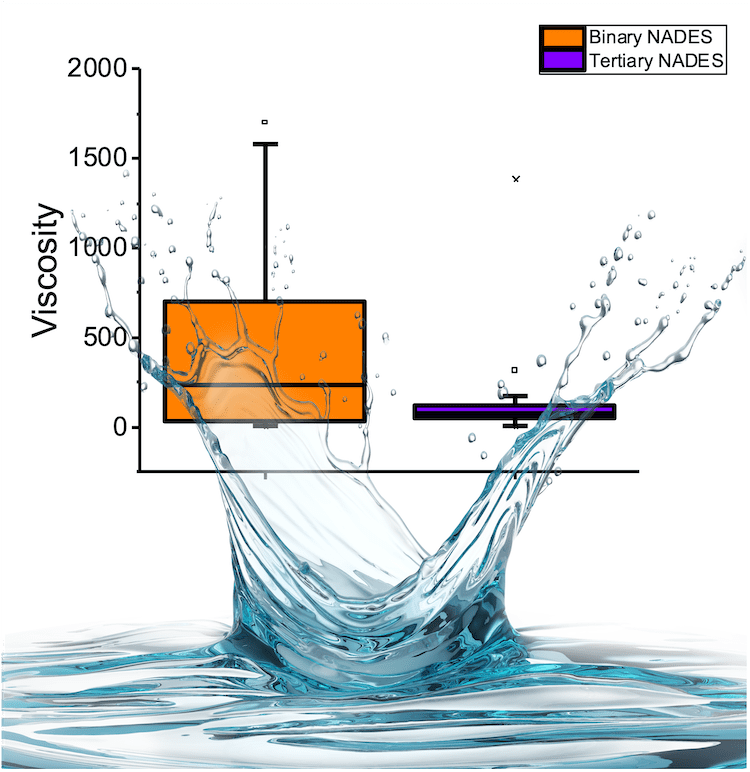
Most reported NADES are highly viscous at room temperature, a characteristic that is attributed to the formation of the hydrogen bonding network among their components and that represents the most pressing obstacle for their implementation in a wide variety of fields. Although different strategies have been presented to overcome this issue, adding water is probably the most effective one . In this regard, some authors state that the addition of water does not affect the interaction of the main components in a NADES, while others argue that water has the potential to modulate the microstructure of DES and the resulting properties, potentially affecting the number of hydrogen bonds as well as the strength of the interaction. Moreover, excessive additions (>40% mole ratio) could compete with the hydrogen bond network and destabilize these eutectic mixtures. Aiming to gain a detailed understanding of the role of hydrogen bonding in these solvents, participants involved with this project will use nuclear Overhauser effect (NOE) experiments in the gel phase to determine both the 1H-1H distances between DES components and the average rotational correlation times of the constituent molecules. Measurements will be made on samples containing differing amounts of water to determine how much water is required to disrupt the hydrogen-bond interactions responsible for DES formation. The high-resolution spectral information this probe provides will also enable participants to observe changes in chemical shifts upon NADES formation. To gain a molecular understanding of the chemical interactions behind the formation and de-stabilization of DES, the experimental aspects of this project will be complemented by computational approaches. For example, participants will have the opportunity to use DFT geometry optimizations to confirm the presence of hydrogen bonds. As overall goals, this project will provide participants the opportunity to work full-time in NMR spectroscopy, generate basic knowledge to enable expanding the use of DES as solvents, and enable determining which systems will be compatible with water and which ones will not.
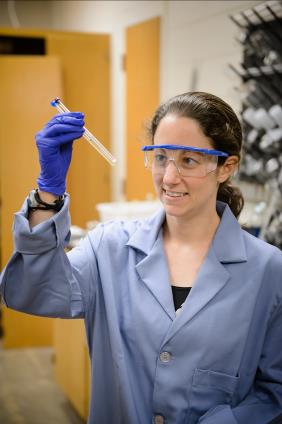
Students working in this project will be mentored by Dr. Leah Casabianca, at Clemson University