SPARC provides integrated experimental, computational, and consultative services to enable high-resolution spatial biology and spatial transcriptomics studies. Our facility supports projects from experimental design and tissue preparation through sequencing, spatial data reconstruction, and biological interpretation.
SPARC services are available to Clemson investigators as well as external academic, government, and industry researchers.
Getting Started
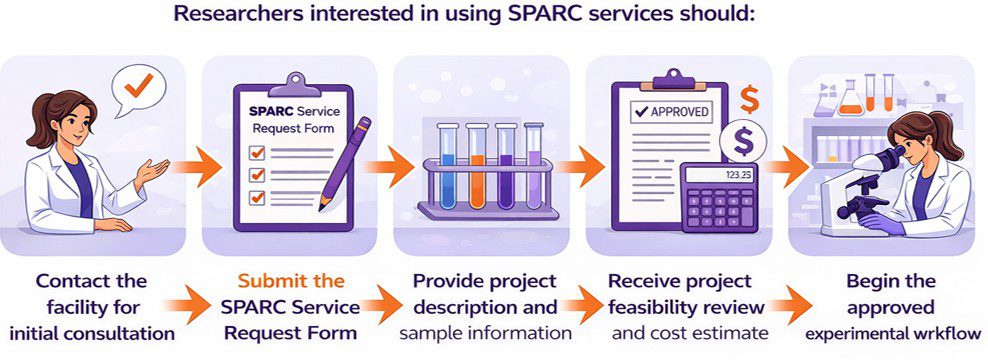
SPARC provides a streamlined process to help researchers move efficiently from project concept to spatial biology data generation. The steps below illustrate how investigators can initiate and execute projects through the SPARC facility.
Getting started
Services and Deliverables
The table below summarizes SPARC service offerings and the standard deliverables provided for each service.
Service
Deliverables
Sample preparation (first sample)
Tissue embedding in OCT (if applicable), cryosectioning, slide mounting, ssDNA/H&E staining, stained brightfield images, and basic section QC notes such as tissue integrity and section thickness.
Sample preparation (additional samples)
Cryosectioning, slide mounting, ssDNA/H&E staining, stained brightfield images, and basic QC notes for each additional sample.
P Chip / technical assistance
P Chip setup and handling, permeabilization optimization and support for that tissue type, permeabilization images, and run notes documenting key conditions used for reproducibility.
Stereo-seq T Chip (0.5 cm × 0.5 cm)
Stereo-seq library construction, sequencing (raw FASTQ), initial demultiplexing, spatial barcode mapping outputs, and a basic run QC summary such as read counts and mapping rate. (Up to 1 billion DNBSEQ reads)
Stereo-seq T Chip (1 cm × 1 cm)
Stereo-seq library construction, sequencing (raw FASTQ), initial demultiplexing, spatial barcode mapping outputs, and a basic run QC summary such as read counts and mapping rate. (Up to 2 billion DNBSEQ reads)
Stereo-seq Omni Chip v1.1 (1 cm × 1 cm)
Omni workflow library construction, sequencing (raw FASTQ), initial demultiplexing, spatial barcode mapping outputs, and a basic run QC summary such as read counts and mapping rate. (Up to 2 billion DNBSEQ reads)
Bioinformatics analysis
Standard processing including alignment/mapping and count matrix generation, spatial clustering and marker-based annotation, spatial feature plots for key genes, basic differential expression if requested, deliverable figures (TIFF, PDF, PNG), and an analysis report summarizing parameters and outputs. Bioinformatics work exceeding the initial estimate will require client approval prior to continuation.