Garima is a 3rd Year PhD student working with her advisor, Dr. Marco Ajello, in Astrophysics. Check out her paper here.
“This paper investigates the nature of a mysterious Astrophysical source. At the heart of large galaxies resides a supermassive black hole, which can form an accretion disc and power energetic jets of particles. The term blazars refer to such systems whose jet is aligned close to our line of sight. If a blazar shows prominent emission lines in its optical spectra, they are known as flat spectrum radio quasars (FSRQs), else they are called BL Lacertae (BL Lacs) objects. Usually, BL Lacs are less luminous than FSRQ sources and are found at low redshift (z<0.5). On the other hand, BL Lacs can accelerate particles to higher energies, thereby showing higher synchrotron peak frequencies, than FSRQs. According to the so-called blazar sequence, BL Lacs as luminous as FSRQs, and with synchrotron peak frequencies > 10^15 Hz, should not exist.However, the source ‘4FGL J1520.8–0348’ found at a high redshift of z=1.46, seems to be an outlier since it has a high luminosity (like FSRQs) as well as a high synchrotron peak frequency (like BL Lacs). Moreover, it also shows a featureless optical spectra. To unveil its true nature, we obtained X-ray observations of the source which allow us to characterize the exact shape of the synchrotron emission. Moreover, we collected the multiwavelength spectral energy distribution of the source and fit it with a physical model to try and answer the question: is this source a bona-fide BL Lac, or is it an FSRQ in disguise?
We found that the underlying system is a ‘blue FSRQ’, whose strong jet emission could swamp out any emission lines in its optical spectra. The evidence provided in this paper highlights this source as a new ‘blue FSRQ’, increasing the population of this mysterious source class. The correct categorization of these high-z sources is vital to successfully understand the physics behind this gradually growing subclass of sources.”
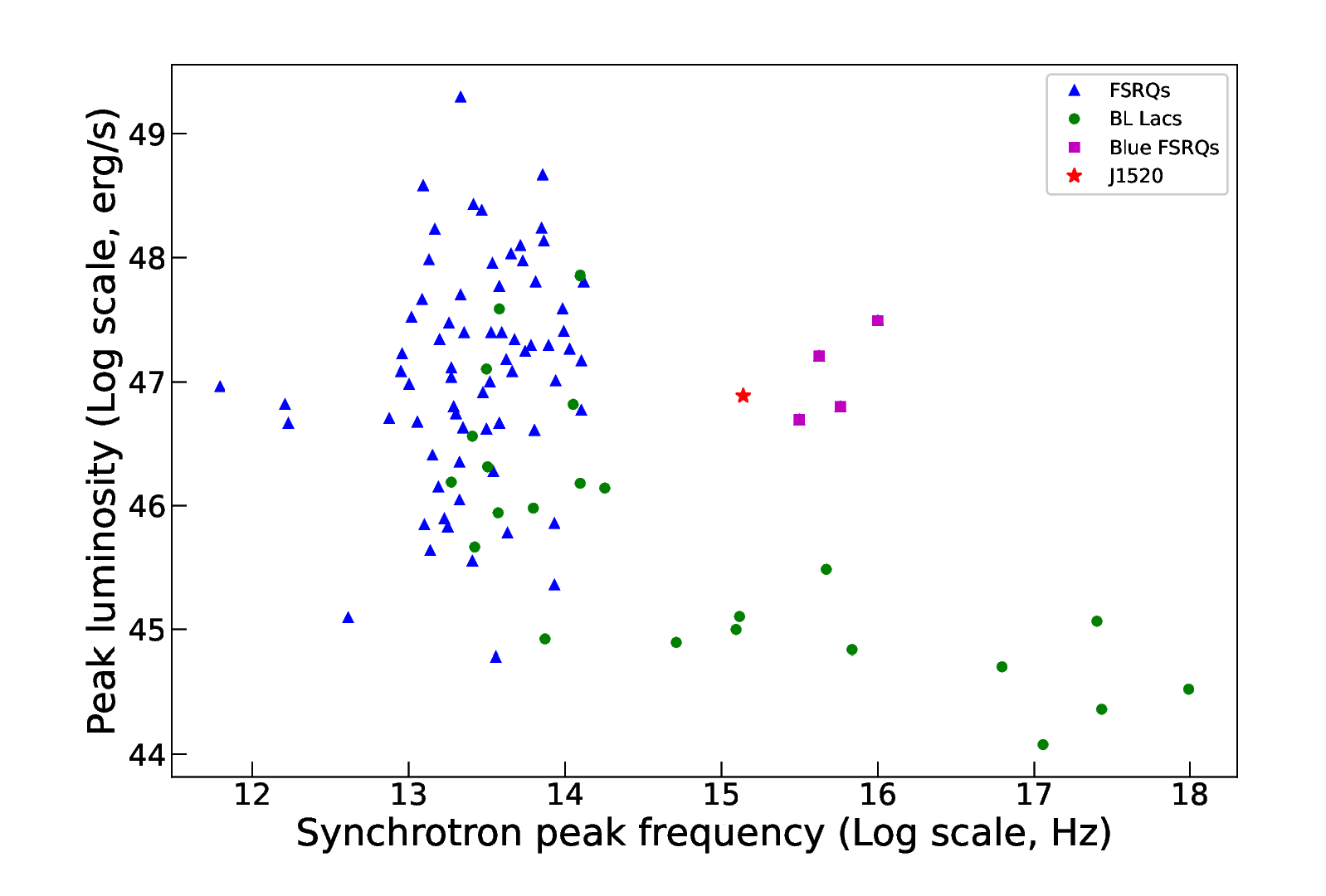
The plot shows the typical positions of FSRQs and BL Lacs in the peak luminosity-peak synchrotron frequency plane. Blue triangles denote FSRQs, green circles are BL Lacs (both datasets come from Padovani et al. 2012). Pink squares are previously found ‘blue FSRQs’ (Ghisellini et al. 2012a; Padovani et al. 2012) and the red star is our source (J1520). We see that our source J1520 is an outlier with respect to FSRQs and BL Lacs, and it lies near the 4 ‘blue FSRQs’ (pink squares).