
Inhibition of Steroid Sulfatase with 4-Substituted Estrone and Estradiol Derivatives

3. Inhibition of Steroid Sulfatase with 4-Substituted Estrone and Estradiol Derivatives

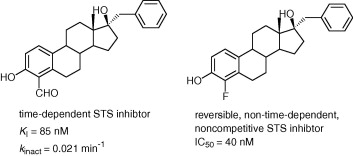
Steroid sulfatase (STS) catalyzes the desulfation of biologically inactive sulfated steroids to yield biologically active desulfated steroids and is currently being examined as a target for therapeutic intervention for the treatment of breast cancer. We previously demonstrated that 4-formyl estrone is a time- and concentration-dependent inhibitor of STS. We have prepared a series of 4-formylated estrogens and examined them as irreversible STS inhibitors. Introducing a formyl, bromo or nitro group at the 2-position of 4-formylestrone resulted in loss of concentration and time-dependent inhibition and a considerable decrease in binding affinity. An estradiol derivative bearing a formyl group at the 4-position and a benzyl group at the 17β-position yielded a potent concentration and time-dependent STS inhibitor with a K(I) of 85 nM and a k(inact) of 0.021 min(-1) (k(inact)/K(I) of 2.3 × 10(5)M(-1)min(-1)). Studies with estrone or estradiol substituted at the 4-position with groups other than a formyl group revealed that good reversible inhibitors can be obtained by introducing small electron withdrawing groups at this position. An estradiol derivative with fluorine at the 4-position and a benzyl group at the 17β-position yielded a potent, reversible inhibitor of STS with an IC(50) of 40 nM. The introduction of relatively small electron withdrawing groups at the 4-position of estrogens and their derivatives may prove to be a general approach to enhancing the potency of estrogen-derived STS inhibitors.
Download PDF »
View on PubMed »
Phan, C.-M.; Liu, Y.; Kim, B.; Mostafa, Y.; Taylor, S. D. Bioorg. Med. Chem. 2011, 19, 5999–6005.
Phthalides by Rhodium-Catalyzed Ketone Hydroacylation

2. Phthalides by Rhodium-Catalyzed Ketone Hydroacylation

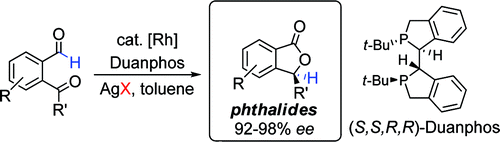
Phthalides are biologically relevant five-membered lactones found in herbs, fruits, and vegetables. Herein we communicate the first atom-economical approach to phthalides by using enantioselective ketone hydroacylation. In the presence of Rh[(Duanphos)]X (X = NO3, OTf, OMs), various 2-ketobenzaldehydes undergo intramolecular hydroacylation to produce phthalide products in good yields and 92−98% ee’s. Our study highlights the key role counterions play in controlling both reactivity and enantioselectivity. A concise asymmetric total synthesis of the celery extract (S)-(−)-3-n-butylphthalide is also presented.
Download PDF »
View on PubMed »

Phan, D. H. T.; Kim, B.; Dong, V. M. J. Am. Soc. Chem. 2009, 131, 15608–15609.

Synthesis of 4-Formyl Estrone Using a Positional Protecting Group and Its Conversion to Other C-4-Substituted Estrogens

1. Synthesis of 4-Formyl Estrone Using a Positional Protecting Group and Its Conversion to Other C-4-Substituted Estrogens

4-Formyl estrone was synthesized in overall good yield in three steps starting from estrone. This was achieved by conducting an electrophilic aromatic substitution reaction using formaldehyde, triethylamine, and MgCl2 on 2-tert-butyl estrone, which was readily prepared in 96% yield from estrone using tert-butyl alcohol and BF3OEt2. The tert-butyl group acted as a positional protecting group to prevent reaction at the 2-position. The tert-butyl group was readily removed in good yield using AlCl3 in dichloromethane/CH3NO2. To our knowledge, this represents the first use of a positional protecting group for the synthesis of a C-4-modified estrogen. 4-Formyl estrone was used as a common precursor to obtain a variety of other C-4 modified estrogens in very high yields such as 4-methylestrone and 4-hydroxymethylestrone as well as the novel estrogen 4-carboxyestrone. The syntheses of 4-formyl, -methyl-, and -hydroxymethyl estrone represent dramatic improvements over previously reported syntheses of these compounds.
Download PDF »
View on PubMed »

Liu, Y.; Kim, B.; Taylor, S. D. J. Org. Chem. 2007, 72, 8824–8830.
